Blog · Commentary
A response to James Cone, and the question of who actually gets to judge whether you are saved.
I keep running into James Cone. Not in the way you plan for, but in the way God keeps setting something in front of you until you finally deal with it.
Back when Nicolette and I were working with Blexit, she sat on a panel discussion in Detroit, and one of the other women on the panel told her to go read Cone's The Cross and the Lynching Tree. Nicolette shut that down on the spot. Here is the ironic part: she and I had already been talking through Black Liberation Theology and Communism for a while before we ever walked into that room. Not debating each other, we are of one mind on it. We were talking about how far both of them drift from the biblical Gospel. So when the name got thrown at her, it was not new to us. It felt more like confirmation of an assignment.
That book is one I plan to examine too. But today I want to start with a different one, God of the Oppressed, because there is a passage in it I cannot just scroll past. I want to put it in front of you in full, because I do not want to argue with a paraphrase or a rumor of what he said. Here are his own words.
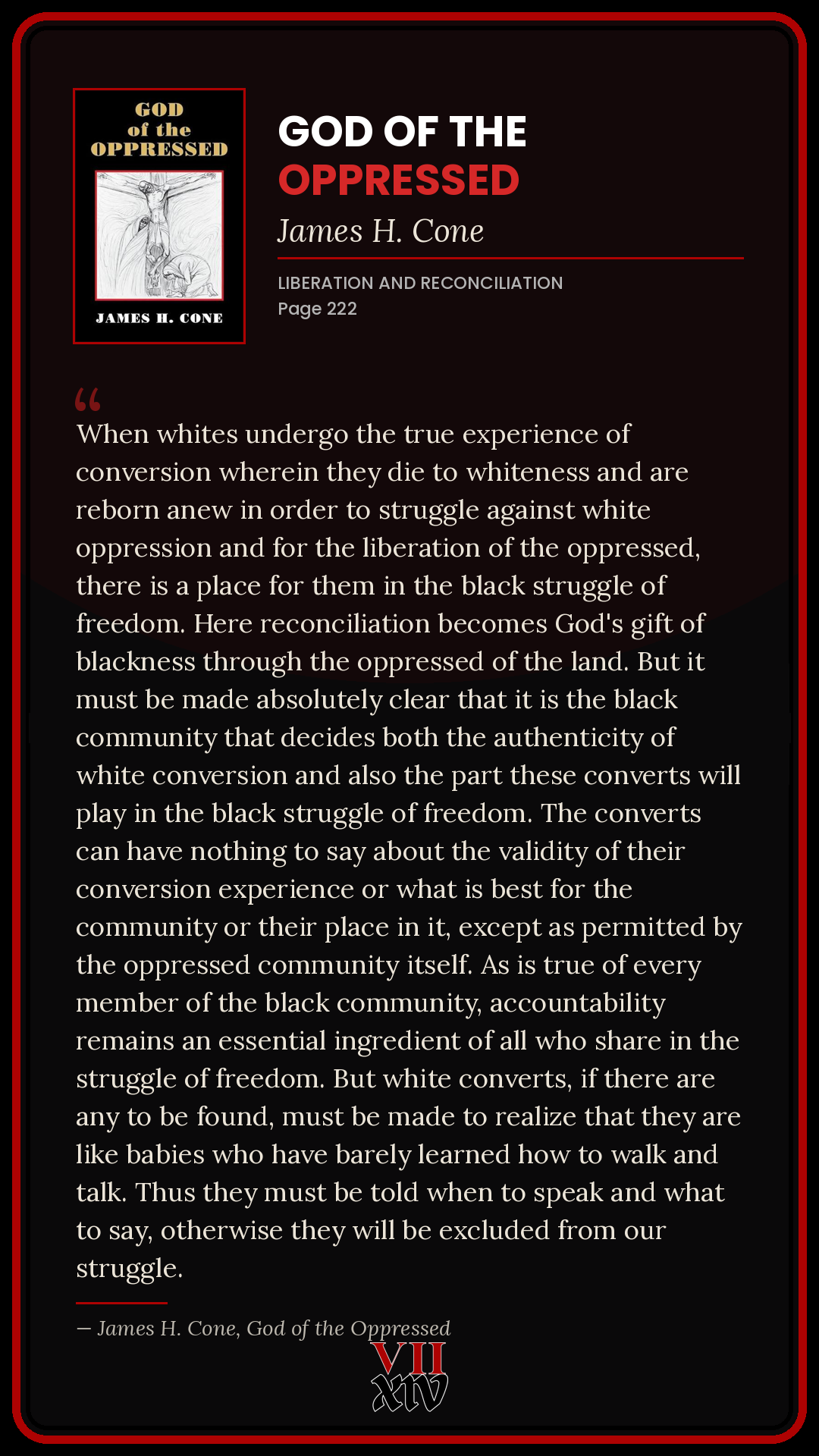
Let's break this down. A community deciding whether your salvation is even real, and handing out permission slips before you are allowed to open your mouth. Converts who "can have nothing to say about the validity of their conversion experience." People told they are "like babies" who must "be told when to speak and what to say."
I am a black man, and I am telling you that is not good news for anybody. It is not the Gospel.
Scripture is clear that God alone reads the heart. “Man looks at the outward appearance, but Yahweh looks at the heart” (1 Samuel 16:7, LSB). It is God who justifies (Romans 8:33), and “the Spirit Himself testifies with our spirit that we are children of God” (Romans 8:16, LSB). No community, black or white, holds that gavel. When God poured out His Spirit on the Gentiles, the verdict was already in:
No distinction. No probation. No gatekeeper standing at the door with a clipboard.
And the cross did not move the dividing wall to a new side. It tore it down.
In Christ there is neither Jew nor Greek (Galatians 3:28). And Paul says it plainly: “from now on we recognize no one according to the flesh” (2 Corinthians 5:16, LSB). Skin color is exactly the kind of fleshly measure he tells us to set down. A few verses later he names reconciliation for what it actually is, God reconciling us to Himself through Christ and then handing that same ministry to every believer (2 Corinthians 5:18-19). It was never one group's gift to grant or to withhold.
And telling converts to sit quiet until they are permitted to speak runs straight into what the Spirit actually does. “To each one is given the manifestation of the Spirit for the common good” (1 Corinthians 12:7, LSB), distributed “just as He wills” (1 Corinthians 12:11, LSB), not as a committee wills. Every believer is part of “a royal priesthood” (1 Peter 2:9, LSB). And showing favor by skin color is not a strategy, it is named as sin: “if you show partiality, you are committing sin” (James 2:9, LSB), because “God is not one to show partiality” (Acts 10:34, LSB).
Now let me be fair to the man, because I want to argue with the real thing and not a cartoon of it. Underneath this, Cone is reacting to something real. He is writing in a specific moment, and he is aiming at cheap reconciliation, the kind that lets comfortable people say the right words on Sunday and change nothing on Monday. The concern about accountability is legitimate. Reconciliation that costs the powerful nothing is not reconciliation at all, and I will walk with him that far.
But here is where I disagree.
If you have ever read George Orwell's Animal Farm, you already know how this ends. The animals were oppressed, so the pigs led the charge, ran the farmer off, and painted one rule on the barn wall for everyone to see: all animals are equal. Nobody over anybody. But the pigs were the ones holding the brush. Little by little they edited that rule, moved into the farmhouse, and learned to walk on two legs, until by the last page you could not tell the pigs apart from the humans they had thrown out. They did not end the oppression. They inherited it and carved their own initials in it.
That is what happens to any framework that tries to fix injustice by handing the gavel to a new group instead of taking it out of human hands altogether. You do not cure partiality by switching whose hand holds the whip. The moment a man's standing before God depends on another man's approval, you have walked off the Gospel and built a brand new law with a brand new set of masters. Christ already bled for that wall to come down. I am not going to help anyone build it back up and paint it a different color.
Accountability, yes. All day. But accountability inside the body of Christ runs to Christ and to His Word, not to any community that appoints itself judge over whether your salvation counts. He tore the wall down. Let it stay down.
Scripture quotations are from the Legacy Standard Bible (LSB).